How 2-1 Interest Rate Buydowns Work (And How to Get the Seller or Builder to Pay for It)
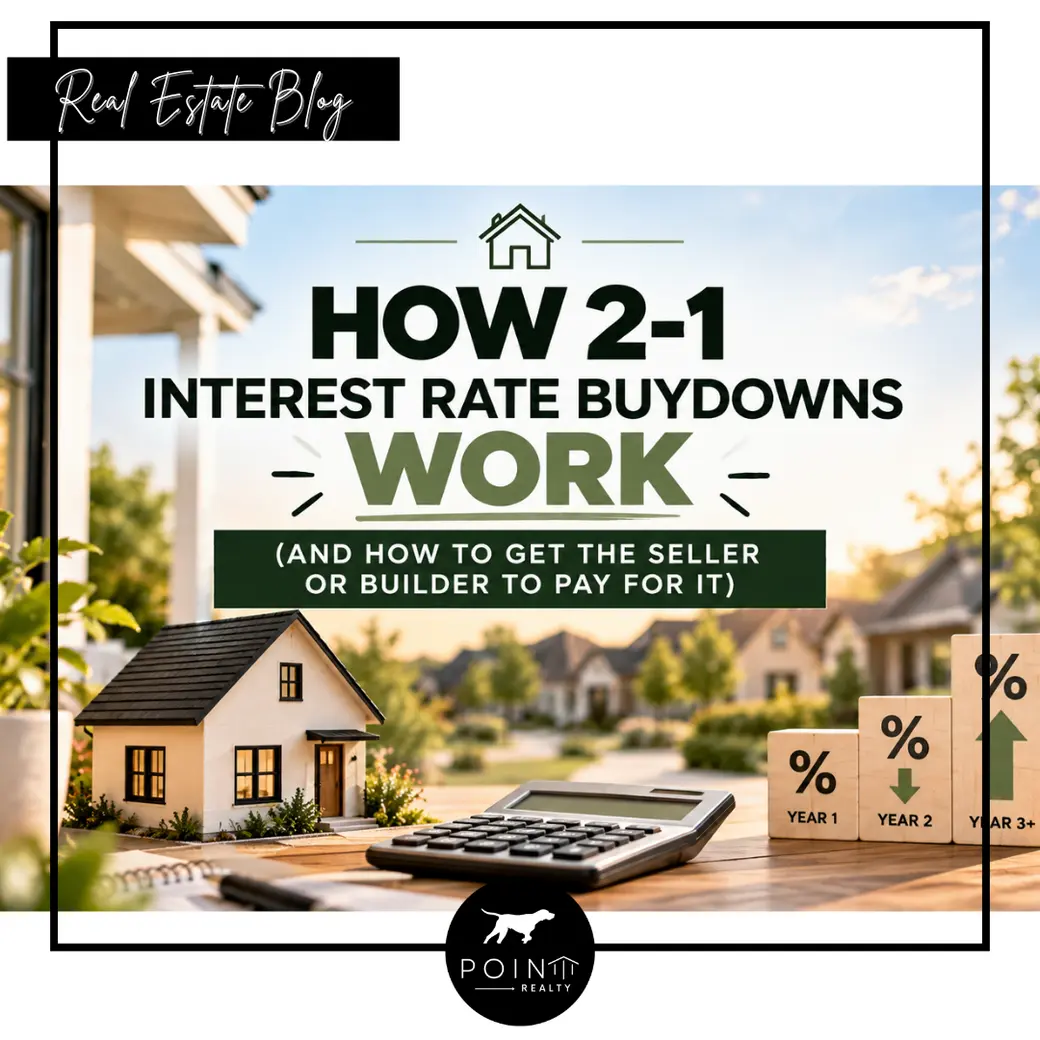
How 2-1 Interest Rate Buydowns Work (And How to Get the Seller or Builder to Pay for It)
If you've been looking at homes in Mansfield, Arlington, Burleson, Grand Prairie, Midlothian or anywhere around DFW lately, you've probably seen some pretty attractive mortgage rate advertisements.
“Rates starting in the 4s!”
“Builder-paid rate buydown!”
“Lower your payment for the first two years!”
Those numbers will definitely get your attention.
But before you fall in love with the payment on the sign, you need to understand what you're actually being offered.
One of the incentives we see is called a 2-1 interest rate buydown.
And when it's structured correctly and someone else is paying for it, I think it can be a really useful tool.
But there's one thing I want every buyer to understand:
Your mortgage rate isn't permanently 2% lower.
So let's break down what a 2-1 buydown actually does, what happens in year three, and—maybe most importantly—how you may be able to get the seller or builder to pay for it.
What Is a 2-1 Interest Rate Buydown?
A 2-1 buydown temporarily reduces the effective interest rate used to calculate the payment you're responsible for during the first two years of your mortgage.
Here's the easiest way to understand it.
Let's say your actual mortgage note rate is 7%.
With a 2-1 buydown:
Year 1: Your payment is based on a 5% rate.
Year 2: Your payment is based on a 6% rate.
Year 3 and beyond: You make the full payment based on your 7% note rate.
Your actual mortgage note rate was 7% all along.
The buydown doesn't rewrite your loan to 5%.
Instead, money is placed into a special account at closing and used to subsidize part of your monthly payment during those first two years.
That's why it's temporary.
What Could That Look Like on a $400,000 Loan?
Let's use a simple hypothetical example.
Assume you're financing $400,000 with a 30-year fixed-rate mortgage at a 7% note rate.
Your approximate principal-and-interest payments would look like this:
Year 1 at an effective 5%: about $2,147/month
Year 2 at an effective 6%: about $2,398/month
Year 3+ at the full 7% note rate: about $2,661/month
That's approximately $514 less per month during year one and $263 less per month during year two.
Remember, those numbers are only principal and interest.
Your actual housing payment can also include property taxes, homeowners insurance, mortgage insurance and HOA dues.
And here in Texas, those other pieces of the payment matter A LOT.
That's why I don't want buyers shopping based solely on an advertised interest rate.
Who Pays the Difference?
This is where the strategy gets interesting.
Someone has to fund that temporary reduction.
Depending on the loan program and transaction, that may be a:
Seller
Builder
Lender
Or another permitted party
The money is generally funded at closing and placed into an account that subsidizes the difference between your temporary payment and the payment required by the actual mortgage.
So when someone tells you they're “giving you a 5% rate for the first year,” they aren't magically changing the economics of the loan.
Someone is paying for that difference.
And if we can negotiate for the SELLER or BUILDER to be that someone instead of you?
Now I'm interested.
How Do You Get a Resale Seller To Pay for a 2-1 Buydown?
This is where having an agent who understands more than simply negotiating the sales price becomes important.
Let's say you're looking at a resale home in Mansfield that's been sitting on the market.
Instead of immediately asking:
“Will the seller take $10,000 less?”
We may want to ask:
“What would happen if we kept the price where it is and asked the seller for a concession that could be used toward an approved 2-1 buydown?”
Depending on your loan, lender, appraisal, contract terms and applicable contribution limits, that may put more money back into your MONTHLY budget during the first two years than a modest reduction in the purchase price would.
That's something buyers often don't realize.
A $10,000 price reduction sounds exciting.
But spread that reduction over a 30-year mortgage and the change in your monthly principal-and-interest payment may be smaller than you expected.
Using that negotiating power differently could potentially have a much greater short-term impact on cash flow.
That's why I want to run the numbers before deciding what we're asking the seller for.
Builders Can Be Even More Aggressive With Rate Incentives
If you're shopping for new construction in Mansfield, Midlothian, Burleson, Waxahachie, Grand Prairie or other growing areas around DFW, you've probably already seen builder financing incentives.
Builders want to sell homes.
And when they have completed inventory sitting there, they can sometimes get pretty creative.
That may include:
Temporary rate buydowns.
Permanent rate buydowns.
Closing-cost assistance.
Price reductions.
Design or upgrade incentives.
Or a combination of incentives.
We talk about this frequently on our South of Cowtown YouTube channel because the advertised price of a new construction home doesn't always tell you what the actual deal looks like.
And I never want my buyers walking into a model home and assuming the first incentive offered is automatically the best one.
Ask questions.
What if we use that incentive toward a permanent rate buydown instead?
What if we use part toward closing costs?
What happens if we choose a quick-move-in home?
Is there an additional incentive for using the builder's preferred lender?
Can incentives be combined?
Sometimes the answer will be no.
Sometimes the answer will surprise you.
A 2-1 Buydown Is NOT an Adjustable-Rate Mortgage
This is another misconception worth clearing up.
A temporary 2-1 buydown and an adjustable-rate mortgage are not the same thing.
With a typical 30-year fixed-rate loan using a 2-1 temporary buydown, your underlying note rate is fixed.
Using our example, it's 7%.
You're simply receiving a temporary subsidy toward your payments during the first two years.
After that subsidy ends, you make the full payment based on the rate that was already established when you closed.
Your mortgage isn't suddenly adjusting because market rates changed.
That's an important distinction.
Here's the Part Buyers REALLY Need To Understand
You generally don't get to qualify for the mortgage based on that artificially lower first-year payment.
For many conventional loans using a temporary buydown, lenders qualify you using the full note-rate payment.
That's actually a good thing.
If our hypothetical mortgage has a 7% note rate, I don't want you buying the house because you can barely afford the year-one payment at 5%.
We need to know you can handle the full payment.
Think of the first two years as breathing room—not as the only reason the house is affordable.
Why Would a Buyer Want Lower Payments for the First Two Years?
This is where I think a 2-1 buydown can make sense for the right buyer.
Moving is expensive.
You may have just used money for your down payment and closing costs.
Then you move in and suddenly realize you need blinds in 14 windows.
And a refrigerator.
And furniture.
And apparently every house needs 47 things from Home Depot during the first six months.
That lower first-year payment can give you some breathing room while you settle into homeownership.
Maybe your income is expected to increase.
Maybe you're transitioning from renting to owning.
Maybe you want to rebuild your savings after closing.
Or maybe you'd simply rather keep some extra room in the monthly budget during the first couple of years.
Those can all be reasons to explore it.
“We'll Just Refinance Before Year Three.”
Be careful with this one.
Could mortgage rates be lower two years from now?
Absolutely.
Could you potentially refinance if they are?
Yes.
But I never want a buyer purchasing a home based on the assumption that refinancing WILL save them later.
None of us knows exactly where mortgage rates will be in two years.
Your home value, credit, income and financial situation can change too.
Buy the house based on a payment you can afford at the full note rate.
If rates eventually drop and refinancing makes financial sense, fantastic.
That's a bonus.
Not the plan required to make the house affordable.
2-1 Buydown vs. Permanent Rate Buydown
This is another conversation worth having with your lender.
A temporary 2-1 buydown gives you more payment relief upfront.
A permanent buydown uses funds to lower the mortgage rate for the life of the loan.
Which is better?
It depends.
How long do you think you'll own the home?
How much does each option cost?
How much does each save monthly?
What are the builder or seller actually willing to contribute?
What happens if you refinance?
I would ask the lender to put BOTH scenarios side by side.
Then we can make a decision based on math instead of marketing.
What Should You Ask for When Making an Offer?
This depends completely on the house and the situation.
If we're looking at a resale home that's been sitting on the market for 50 days, our strategy may be different from a house that was listed yesterday and already has multiple offers.
The same thing happens with builders.
A builder with several completed homes may negotiate differently than a builder in a community where everything is selling quickly.
This is why I don't like blanket rules like:
“Always offer 10% under asking.”
Or:
“Always ask for closing costs.”
That's not how good negotiating works.
First, we find out what matters to the seller or builder.
Then we figure out what matters most to YOU.
Maybe that's price.
Maybe that's cash needed at closing.
Maybe it's the monthly payment.
Maybe it's a 2-1 buydown.
Then we structure the offer around those priorities.
The Bottom Line
A 2-1 interest rate buydown isn't a trick for getting a permanently low mortgage rate.
It's a temporary subsidy that can lower your payment during your first two years of owning the home.
And when a seller or builder is willing to fund it, it can be a valuable negotiating tool.
The important thing is to look beyond the advertised rate.
If you're buying in Mansfield, Arlington, Grand Prairie, Burleson, Midlothian or anywhere around South DFW, let's compare the whole deal:
The home price.
The actual note rate.
The temporary payment.
The year-three payment.
Property taxes.
Insurance.
HOA or special district costs.
Closing costs.
And any seller or builder incentives available.
Because the best deal isn't always the house with the biggest price reduction.
Sometimes it's the deal that puts you in the right house with a payment and cash-to-close number that actually work for your life.
John and I share more home-buying strategies, builder incentives, new construction tours and local market information on our South of Cowtown YouTube channel.
And if you're considering buying, don't be afraid to ask us to run the numbers before you start touring homes.
Knowing what to negotiate for can sometimes be just as important as finding the house.
— Stephanie Deeds
The Deeds Group at Point Realty
South of Cowtown with The Deeds
Categories
- All Blogs 478
- Buying A Home 52
- Community Neighborhood Guides 5
- DFW Lifestyle 23
- Eat, Drink, & Shop Local 2
- First Time Home Buyer Tips 158
- Homeownership Tips & Tricks 12
- Living in Arlington, TX 7
- Living in Burleson 7
- Living in Dallas Fort Worth Metroplex 75
- Living In Texas 16
- Mansfield, TX 14
- Midlothian, TX 13
- Mortgage Rates, Financing, and Affordability 35
- New Construction & Developments in DFW 11
- Real Estate Investing 32
- Real Estate News 49
- Rentals, Property Management, & Leasing 9
- Selling Your House 158
- Texas Relocation Guide 35
- Things To Do in DFW 4
Recent Posts








MY BLOGS
 How 2-1 Interest Rate Buydowns Work (And How to Get the Seller or Builder to Pay for It) If you've been looking at homes in Mansfield, Arlington, Burleson, Grand Prairie, Midlothian or anywhere around DFW lately, you've probably seen some pretty attractive mortgage rate advertisements. “Rates starti
- Resale vs. Builder Upgrade: Should You Trade Your Starter Home for New Construction? There comes a point when the house you were SO excited to buy starts feeling a little…small. Maybe that three-bedroom starter home was perfect when you bought it. Then came another child. Or working from home. Or yo
- A First-Time Homebuyer’s Guide to Burleson, Texas If you're thinking about buying your first home in the Dallas–Fort Worth area, Burleson, Texas should absolutely be on your radar. I talk to first-time buyers all the time who start their search with Mansfield, Arlington or Fort Worth because those a
- Want a More Affordable Home in DFW? Don't Overlook Condos and Townhomes If you've been searching for your first home in Mansfield, Arlington, Burleson, Grand Prairie, or anywhere around Dallas–Fort Worth, I have a question for you. Have you been searching exclusively for single-family homes? You kno
MY BLOGS
- How 2-1 Interest Rate Buydowns Work (And How to Get the Seller or Builder to Pay for It)
- Resale vs. Builder Upgrade: Should You Trade Your Starter Home for New Construction?
- A First-Time Homebuyer’s Guide to Burleson, Texas

MY BLOGS
Local News, Events & More Emailed Daily!